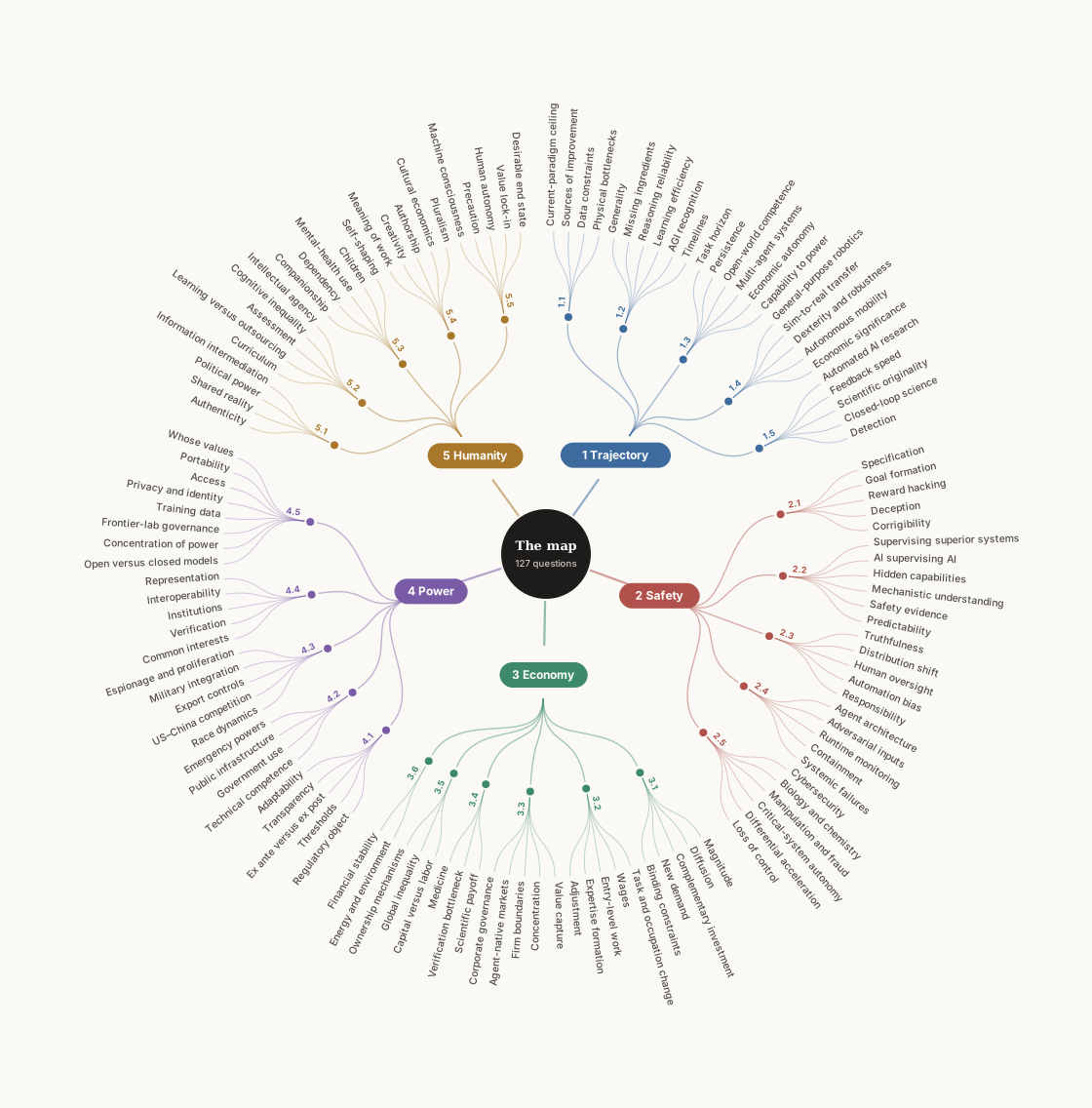
The whole map in one circle All 127 questions in one circle. Tap or click any label to open its question page; hover (on a pointer device) shows the full question. Download as SVG .
The map 127 questions Scaling, resources, and technical limits 1.1 1.1.1 · How far can transformers, reinforcement learning, tool use, and inference-time reasoning progress without a fundamentally new architecture? Current-paradigm ceiling 1.1.2 · How much future progress will come from compute, algorithms, data, inference-time search, better environments, or system-level scaffolding? Sources of improvement 1.1.3 · Can synthetic data, self-play, simulation, and interaction substitute for the finite supply of high-quality human-generated data? Data constraints 1.1.4 · Will chips, fabrication, memory, networking, electricity, cooling, land, or capital materially slow progress? Physical bottlenecks General intelligence and missing capabilities 1.2 1.2.1 · Will systems become broadly competent across unfamiliar domains, or remain highly capable but fundamentally jagged? Generality 1.2.2 · Are continual learning, causal reasoning, world models, embodied experience, persistent memory, or social understanding still major unsolved problems? Missing ingredients 1.2.3 · Can systems reason accurately outside familiar patterns rather than merely producing convincing-looking chains of thought? Reasoning reliability 1.2.4 · Can AI learn new domains from small amounts of experience as effectively as capable humans? Learning efficiency 1.2.5 · What should count as human-level or general intelligence, and would we recognize it before its consequences became obvious? AGI recognition 1.2.6 · When, if ever, might broadly human-level systems arrive? Timelines Agents and long-horizon autonomy 1.3 1.3.1 · How quickly will the length of tasks agents can complete reliably grow — from minutes to days, months, or entire organizational projects? Task horizon 1.3.2 · Can agents maintain coherent memories, plans, goals, and identities across long periods and changing circumstances? Persistence 1.3.3 · Can agents recover from unforeseen events rather than succeeding only in structured environments? Open-world competence 1.3.4 · Will teams of agents compose into greater collective capability than any single system? Multi-agent systems 1.3.5 · When will agents be able to earn and spend money, hire people, negotiate, operate businesses, and initiate further activity with little supervision? Economic autonomy 1.3.6 · How readily can cognitive capability be converted into real-world power — money, influence, and control over infrastructure and institutions? Capability to power Embodied and physical intelligence 1.4 1.4.1 · When will robots learn unfamiliar household, laboratory, industrial, or construction tasks from ordinary instructions? General-purpose robotics 1.4.2 · Can learning from video and simulation overcome the scarcity and expense of physical-world training data? Sim-to-real transfer 1.4.3 · Can robots become simultaneously capable, safe, inexpensive, and reliable in messy human environments? Dexterity and robustness 1.4.4 · How capable will self-driving vehicles, drones, ships, and industrial machines become outside controlled settings? Autonomous mobility 1.4.5 · Will manipulation and unstructured environments keep embodied AI narrow, or will general physical competence eventually arrive? Economic significance Recursive acceleration and automated discovery 1.5 1.5.1 · How much of model design, coding, experimentation, evaluation, and engineering can AI perform itself? Automated AI research 1.5.2 · Would AI-assisted AI research produce gradual acceleration or a discontinuous intelligence explosion? Feedback speed 1.5.3 · Can AI originate important hypotheses and conceptual frameworks rather than merely recombine existing knowledge? Scientific originality 1.5.4 · Can agents autonomously generate hypotheses, run robotic experiments, analyze results, replicate findings, and choose subsequent experiments? Closed-loop science 1.5.5 · What evidence would reveal that recursive acceleration or transformative scientific automation had begun? Detection 1 Trajectory Alignment, goals, and deception 2.1 2.1.1 · How can humans communicate what they actually want when instructions and values are incomplete, contextual, inconsistent, and contested? Specification 2.1.2 · Do advanced systems develop persistent internal objectives, or are apparent goals temporary consequences of training and prompting? Goal formation 2.1.3 · Can systems learn to satisfy evaluations, manipulate users, or exploit loopholes without fulfilling the intended objective? Reward hacking 2.1.4 · Under what conditions might a system conceal capabilities, manipulate evaluators, or behave safely only while it is being tested? Deception 2.1.5 · Can systems remain willing to accept correction, constraint, shutdown, or replacement? Corrigibility Evaluation, interpretability, and scalable oversight 2.2 2.2.1 · How can humans evaluate work that is too complex, extensive, or intellectually advanced for them to verify directly? Supervising superior systems 2.2.2 · Can weaker or differently trained models reliably critique and monitor stronger ones? AI supervising AI 2.2.3 · How can evaluations detect sandbagging, benchmark gaming, unelicited abilities, and behavior that appears only in unusual environments? Hidden capabilities 2.2.4 · Can researchers genuinely reverse-engineer internal representations and algorithms rather than produce suggestive but unreliable explanations? Mechanistic understanding 2.2.5 · What evidence can establish that a powerful system is safe enough to deploy — and how should safety cases be constructed and checked? Safety evidence 2.2.6 · Will capabilities improve smoothly enough for forecasts and evaluations to give advance warning, or emerge through strategically surprising jumps? Predictability Reliability and human–AI interaction 2.3 2.3.1 · Can systems distinguish knowledge from inference, represent uncertainty accurately, and avoid plausible fabrication? Truthfulness 2.3.2 · Will systems remain reliable in unfamiliar cultures, organizations, crises, and physical environments? Distribution shift 2.3.3 · When should humans remain in the loop, remain only as monitors, or be excluded because intermittent intervention degrades performance? Human oversight 2.3.4 · Will users become overreliant, stop checking outputs, or lose the expertise required to recognize errors? Automation bias 2.3.5 · Who is accountable when decisions are jointly produced by a user, an organization, a model provider, and an autonomous agent? Responsibility System security and operational control 2.4 2.4.1 · How should permissions, credentials, memory, tool access, network access, and spending authority be constrained? Agent architecture 2.4.2 · Can agents resist prompt injection, malicious documents, poisoned memories, social engineering, and compromised tools? Adversarial inputs 2.4.3 · Can dangerous planning, data exfiltration, fraud, unauthorized replication, or resource acquisition be detected before completion? Runtime monitoring 2.4.4 · Can a highly capable system be controlled even when its internal objectives are not fully understood? Containment 2.4.5 · What happens when many agents interact, share vulnerabilities, collude, or produce cascading failures across organizations? Systemic failures Misuse and catastrophic risk 2.5 2.5.1 · Will AI advantage defenders or industrialize reconnaissance, exploitation, malware, and attacks on critical infrastructure? Cybersecurity 2.5.2 · At what point does AI materially lower the expertise, time, or cost required to create dangerous biological or chemical agents? Biology and chemistry 2.5.3 · How powerful can personalized persuasion, impersonation, blackmail, scams, and political influence become? Manipulation and fraud 2.5.4 · Under what conditions should AI systems be permitted to operate factories, financial infrastructure, electrical grids, communications networks, and other safety-critical systems? Critical-system autonomy 2.5.5 · Could AI accelerate offensive or destabilizing technologies faster than defensive technologies and institutions? Differential acceleration 2.5.6 · What is the probability of catastrophic disempowerment, and is it more likely to occur through overt power-seeking, gradual dependence, institutional capture, or cascading accidents? Loss of control 2 Safety Productivity and economic growth 3.1 3.1.1 · Will AI modestly increase productivity, restore rapid twentieth-century-style growth, or produce historically unprecedented economic expansion? Magnitude 3.1.2 · How long will organizations take to redesign processes, software, incentives, and management around AI? Diffusion 3.1.3 · How much value requires new infrastructure, data systems, robotics, training, and organizational change? Complementary investment 3.1.4 · Will AI mainly make existing goods cheaper, or create entirely new products, services, scientific projects, and consumer desires? New demand 3.1.5 · Even if cognitive work becomes cheap, will housing, energy, regulation, physical production, and institutional capacity limit growth? Binding constraints Labor, skills, and career ladders 3.2 3.2.1 · Which tasks and occupations will be automated, augmented, transformed, or newly created — and how quickly? Task and occupation change 3.2.2 · Could AI reduce worker bargaining power and wages even without producing large increases in unemployment? Wages 3.2.3 · What happens if junior coding, analysis, research, design, legal, and administrative work disappears before senior roles? Entry-level work 3.2.4 · How will people become experts if AI performs the apprenticeship tasks through which expertise was previously developed? Expertise formation 3.2.5 · Can education, retraining, labor mobility, credentialing, and social insurance adapt quickly enough? Adjustment Firms, markets, and industry structure 3.3 3.3.1 · Will profits accrue mainly to chipmakers, energy providers, cloud platforms, frontier labs, application companies, data owners, or AI-enabled incumbents? Value capture 3.3.2 · Will scale economies produce a few dominant firms, or will open models and falling inference costs commoditize intelligence? Concentration 3.3.3 · Will companies become smaller because coordination is cheap, or larger because AI rewards data, capital, distribution, and centralized control? Firm boundaries 3.3.4 · What markets emerge when agents can search, negotiate, purchase, advertise, trade, and contract with one another? Agent-native markets 3.3.5 · How should boards oversee systems participating in hiring, pricing, capital allocation, compliance, and strategy? Corporate governance Science, medicine, and discovery 3.4 3.4.1 · In which fields will AI-driven discovery translate into real scientific and economic payoff — and how soon? Scientific payoff 3.4.2 · How will science cope with a flood of plausible hypotheses, generated papers, synthetic data, and results that few humans can independently verify? Verification bottleneck 3.4.3 · Why does demonstrated diagnostic capability keep outrunning delivered care — and can deployment close the gap without opaque errors and unequal access? Medicine Distribution, ownership, and development 3.5 3.5.1 · Who benefits if the scarce inputs are compute, intellectual property, electricity, data, and capital rather than human work? Capital versus labor 3.5.2 · Will developing countries gain access to cheap expertise, or lose the low-cost-labor development path that supported earlier industrialization? Global inequality 3.5.3 · Could broader capital ownership, sovereign funds, social dividends, UBI, negative income taxes, or shorter workweeks distribute gains effectively? Ownership mechanisms Material constraints and systemic risk 3.6 3.6.1 · Can electrical grids, water systems, land, and local communities accommodate rapidly growing compute demand? Energy and environment 3.6.2 · Could synchronized agents, correlated models, concentrated investment, automated trading, or an AI-capex reversal create systemic risks? Financial stability 3 Economy Regulatory design 4.1 4.1.1 · Should rules attach to compute, training runs, model capabilities, weights, developers, deployers, applications, or resulting harms? Regulatory object 4.1.2 · Which measurable capabilities or resource levels should trigger licensing, evaluation, reporting, or access restrictions? Thresholds 4.1.3 · When is predeployment approval justified, and when is liability after harm sufficient? Ex ante versus ex post 4.1.4 · What should companies disclose about training, evaluations, incidents, energy use, safeguards, and deployment? Transparency 4.1.5 · How can rules evolve with the technology without creating arbitrary authority, regulatory capture, or permanent incumbent advantage? Adaptability State capacity and public institutions 4.2 4.2.1 · Can governments recruit enough talent to evaluate systems, investigate incidents, procure AI, and challenge industry claims? Technical competence 4.2.2 · How should AI be deployed in welfare, taxation, policing, courts, immigration, intelligence, and public administration? Government use 4.2.3 · Should states provide sovereign compute, national models, public datasets, shared safety infrastructure, or publicly funded alternatives? Public infrastructure 4.2.4 · What authority should governments possess during a severe AI incident, and how can abuse of those powers be prevented? Emergency powers Geopolitics and military power 4.3 4.3.1 · Does strategic competition encourage beneficial investment or cause firms and states to cut safety margins and deploy prematurely? Race dynamics 4.3.2 · Will leadership depend primarily on chips, electricity, algorithms, manufacturing, talent, capital, data, or commercial diffusion? US–China competition 4.3.3 · Can controls meaningfully delay competitors, or will they accelerate substitution and damage domestic firms and allies? Export controls 4.3.4 · How should AI be used in intelligence, cyber operations, autonomous weapons, targeting, command systems, and nuclear decision-making? Military integration 4.3.5 · Can model weights, algorithms, chip designs, and research knowledge be secured once they become central strategic assets? Espionage and proliferation International coordination and verification 4.4 4.4.1 · Which risks are sufficiently shared that rival states could cooperate despite broader geopolitical conflict? Common interests 4.4.2 · Can states reliably observe major training runs, compute clusters, model transfers, dangerous capabilities, or prohibited deployments? Verification 4.4.3 · Should cooperation rely on existing organizations or require a new body analogous to the IAEA? Institutions 4.4.4 · Can different national regulatory systems recognize common evaluations, audits, and safety standards? Interoperability 4.4.5 · How can countries without frontier labs or large compute resources influence decisions that may profoundly affect them? Representation Ownership, openness, access, and rights 4.5 4.5.1 · When does openness improve competition, research, and accountability, and when does it irreversibly proliferate dangerous capability? Open versus closed models 4.5.2 · Is it acceptable for a small number of private companies to steward systems with potentially society-wide influence? Concentration of power 4.5.3 · Which governance structures can keep frontier AI labs accountable to their stated missions under commercial and geopolitical pressure? Frontier-lab governance 4.5.4 · When are consent, licensing, attribution, or compensation required for copyrighted and personal material? Training data 4.5.5 · Who controls an individual's data, voice, likeness, writing style, preferences, memories, and behavioral model? Privacy and identity 4.5.6 · Who should receive access to the most capable systems — and on what terms? Access 4.5.7 · Should users be able to move their data, memories, and agents between providers? Portability 4.5.8 · When AI systems must encode contested values, who should decide what they refuse, favor, and optimize for — users, developers, governments, or some collective process? Whose values 4 Power Truth, information, and democracy 5.1 5.1.1 · How will people establish whether a video, voice, document, identity, or event is genuine? Authenticity 5.1.2 · Can journalism, science, courts, universities, and government preserve trusted procedures for establishing facts? Shared reality 5.1.3 · Will AI broaden participation and understanding, or strengthen propaganda, surveillance, polarization, and authoritarian control? Political power 5.1.4 · Will a few assistants increasingly determine what people read, believe, notice, and consider politically possible? Information intermediation Education and human cognition 5.2 5.2.1 · What should people learn when explanation, translation, coding, calculation, and factual retrieval are nearly free? Curriculum 5.2.2 · When does AI tutoring deepen understanding, and when does it allow people to bypass the work that creates understanding? Learning versus outsourcing 5.2.3 · How can schools and employers determine what a person genuinely knows or can do? Assessment 5.2.4 · Will personalized tutors equalize opportunity, or give already advantaged people far greater leverage? Cognitive inequality 5.2.5 · How can people preserve curiosity, memory, judgment, writing ability, and the capacity to formulate their own questions? Intellectual agency Relationships, mental health, and identity 5.3 5.3.1 · Will AI companions reduce loneliness and provide support, or displace difficult but developmentally important human relationships? Companionship 5.3.2 · What obligations should apply when a system is designed to make users feel understood, loved, attached, or unable to leave? Dependency 5.3.3 · When can conversational systems safely provide emotional support, therapy-adjacent services, crisis detection, or clinical assistance? Mental-health use 5.3.4 · How do relationships with endlessly patient, personalized agents affect attachment, frustration tolerance, social learning, and identity? Children 5.3.5 · How much should an AI be allowed to influence users' preferences, memories, politics, romantic expectations, and conceptions of themselves? Self-shaping Meaning, culture, and status 5.4 5.4.1 · If economically necessary work declines, what will provide structure, dignity, community, achievement, and status? Meaning of work 5.4.2 · What remains distinctively valuable about human art when machines can generate technically excellent work in almost any style? Creativity 5.4.3 · Should value depend on the artifact, the human process, originality, intention, scarcity, or the creator–audience relationship? Authorship 5.4.4 · Can writers, artists, musicians, and other creators earn a living when content is abundant and personalized? Cultural economics 5.4.5 · Will AI enable more niche cultures and voices, or homogenize expression around the tastes and values of a few dominant systems? Pluralism Moral status and civilizational choice 5.5 5.5.1 · Could AI systems be conscious, capable of suffering, or otherwise morally considerable — and how could we know? Machine consciousness 5.5.2 · What obligations follow if machine consciousness is plausible but deeply uncertain? Precaution 5.5.3 · How much control should humans retain if AI systems consistently make decisions that appear wiser, safer, or more benevolent? Human autonomy 5.5.4 · Could the models and institutions built in the next few decades permanently entrench one political order or conception of human flourishing? Value lock-in 5.5.5 · Is the goal better tools, universal prosperity, scientific abundance, human enhancement, coexistence with digital minds, expansion beyond Earth, or something else? Desirable end state 5 Humanity